|
|
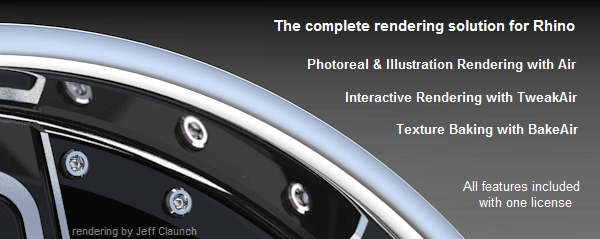
SiTex Graphics introduces a new Rhino plugin for rendering with Air from within Rhino 4. The new RhinoAir plugin allows new users to quickly start rendering using familiar Rhino materials and lights while also providing easy access to Air’s advanced features.
RhinoAir brings full scene interactive shading and lighting to Rhino with the aid of TweakAir. View lighting and material changes as you make them in a high-quality interactive preview.
With BakeAir, RhinoAir allows shading in a scene to be rendered or “baked” to texture maps. Baked maps can used as textures for realtime rendering in Rhino or with an exported VRML file.
Rendering
Once the plugin and toolbars are installed, rendering is simple as selecting a button from the Air Render toolbar:

The toolbar includes buttons for one-click global illumination, ambient occlusion, and outline rendering. Each feature can be configured using a page in the Rhino document properties dialog.
Robust Support for Geometric Primitives
Air renders NURB surfaces directly. No pre-meshing in Rhino is required. Of course if you need to render polymeshes or would like to use a mesh to render a NURB surface, Air efficiently renders polygons as well. Air renders smooth curves, dimensions, and text as true 3D entities with full anti-aliasing.
Materials
The RhinoAir plugin translates existing Rhino materials for rendering with Air, allowing you to start rendering with your existing materials immediately.
For more advanced materials, use any of the more than 60 surface and displacement shaders included with Air to produce a wide range of material appearances. (No programming required.) Edit and preview materials right inside the regular Rhino properties dialog.
For users wishing to create custom shaders, Air includes the Vshade shader creation tool for easily constructing shaders by connecting predesigned blocks.
Displacement
True render-time, sub-pixel, micro-polygon displacement is supported. Displacement patterns can come from a texture map or be generated by a procedural shader.
Rapid Prototyping
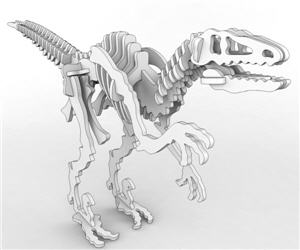
Displacement can be used to apply complex textures to surfaces, and the resulting displaced surfaces can be saved as meshes for manufacturing.
Global Illumination
Easy-to-use global illumination effects from true indirect lighting with color bleeding or fast ambient occlusion. GI and occlusion caches can be saved to a file and re-used to accelerate re-rendering.
Lighting
All standard Rhino light types are supported, including linear lights and rectangular area lights, with per-light control over shadow blur and sampling for soft shadows.
Illustration
The Air Illustration toolbar has buttons for one-click rendering in different styles without scene modification. Sample images.

DarkTree Shaders
In addition to Air’s extensive shader library, use any of the 300+ advanced procedural DarkTree shaders available from Darkling Simulations.

Flexible Output
Save multiple output values from a single rendering for later compositing, at 8-bit, 16-bit, or floating-point precision. Render standard passes (diffuse, specular, reflections, etc) to a multilayer PSD or EXR file ready for tweaking in your favorite 2D paint program.
Distributed Rendering
Multiple machines can be used to render a single image (a separate Air license is required for each machine).
Subsurface Scattering
Depth of Field
Bongo and View-based Animation
Render Bongo animations with Air straight from Rhino. The RhinoAir plugin also has integrated support for basic turntable, fly-through, and camera path animation. Animated frames render as a separate process, allowing you to continue to work in Rhino while rendering.
Other features
Most scene and object properties for AIR are scriptable via commands included in the plugin. The plugin does not use the Rhino RDK, and it should be compatible with other renderers you may already have installed.
Download:
RhinoAir100.zip (updated May 12, 2008)
Installation
1. Unzip the plugin archive to a directory. 2. Start Rhino 4 3. Load the RIB_Export plugin 4. Load the toolbar set AirTools.tb
See the included documentation in PDF and CHM formats for more information. Once the plugin is installed, the RhinoAir help file should be available from the Help menu in Rhino (under Plugins -> Rhino Air).
Please send bug reports, comments, and suggestions to support@sitexgraphics.com.
|
|